Back to Selected Works
Essay
Butterfly Dreams / 蝴蝶夢
Author: Raymond Ku
|
When I think back to my childhood, especially the first few years, the images always seem to appear in black and white. From the countryside in Hunan, China, and the hard journey with mother all the way to Taiwan, to the huge Japanese style house with walled-in yards, the remembrance is filled with shadows of gray, like watching ancient monotone movies.
But there is one thing buried deep in my heart that carries a special meaning. They fly and dance around the pond, by the bushes, and between flowers: the butterflies. In my memory, they are always vivid with bright colors.
I was first drawn to them when I was five years old. I chased after them all the time, forgetting where I was and tripping over the rocks by the pond or getting tangled in thorny bushes and becoming swollen with rashes all over my body. In kindergarten, I made new friends, and there were many games the kids played in the neighborhood. Some games, though, like cricket fighting, and war games, were favorites only among the boys. With the girls, we played hide-and-seek, rope jumping, and “walk-the-butterfly.”
I liked cricket fighting, but I liked walk-the-butterfly even more. This is how you play the game: each kid wanders in the yard and tries to attract a butterfly to land on him or her. The kid then walks with the butterfly along a pre-determined course, around certain bushes and trees, up the pagoda, through the patio, around the front yard, and so on, until the butterfly leaves him/her. The kid who walks the farthest with the butterfly wins. You can walk in any way that you like, at any speed.
The fun part of this game is not only in how each kid avoids disturbing the butterfly, but also in the variety of ways the kids move. Some tiptoe like a thief; some crawl like a crab; some wobble like a duckling, or inch on like a zombie with a frozen stare. Some simply get on all fours and crawl on the ground, and some try to move painfully slowly while mumbling, as if sweet-talking the butterfly to stay longer… It’s enormous fun watching others in this game. We used to laugh so hard that we fell to the ground.
But I never won the game once. Perhaps I was too nervous. I thought if I made a swift dash before the butterfly knew what was happening, I could run a greater distance than if I crawled. That method didn’t work too well. I, of course, tried other ways, like moving in a super smooth and slow motion. I learned to use whistling, too, thinking that maybe the butterflies would be attracted by music.
The summer flower season was nearing its end. Since I hadn’t made any progress in cricket fighting or card games, I really wanted to win “walk-the-butterfly” at least once. One day, I figured out a way. Through observation, I reasoned that the butterflies wouldn’t stay on me too long because of the clothes I was wearing, which were not as natural a place for them to hang around as the bushes, the trees, and the pond. It seemed that they stayed longer on people’s bare neck or arm.
So I took all my clothes off, crouched by the pond and waited for them.
This distracted all the kids in the game. They were either shocked at my sudden nakedness or laughing their heads off. I ignored them and concentrated on my experiment.
Then one butterfly came and parked on my hair. I tiptoed and moved four paces, and it flew away. I crouched down and waited again. Another came and stopped on my left shoulder, but it left as soon as I stood up. Disappointed, I decided to try one more time before giving up. It was then I heard, from across the yard, across the wide blue sky, a loud shriek!
It was mother, standing on the back porch, her face white with anger and her mouth wide open. Other kids hastened their escape through the front door.
After that I was permanently grounded as far as “walk-the-butterfly” was concerned.
But I didn’t give up on butterflies that easily.
Although I couldn’t play the game, there was no rule against me bringing them into the house. So I started to collect caterpillars. By then I was in first grade.
I built little housing units for the caterpillars with tiny pieces of wood, rocks and twigs. I talked to them. I trained them. I encouraged them to stay within their units, or else, I threatened without meaning it, I would see to it that they didn’t become beautiful butterflies.
But, after a while, the twenty or thirty caterpillars started to disappear, in spite of all my caring effort, which included a daily supply of fresh morning dew and young boysenberry leaves, along with my own singing.
Finally, there were only two little green worms left. One of them had an orange red spot by its head, and the other had a line of black dots along its body. So I named them “Red Dot” and “Black Dot”. If you touched their heads lightly, two bright yellow feelers would stick out from both sides.
Within a couple of days, Red Dot also disappeared. When I found it, it had already become a tiny mess of green, apparently a victim under someone's slipper. Fortunately, in the same afternoon, Black Dot started to make silk, slowly weaving it into a cocoon.
Nothing can describe my excitement then. The silk was white with a soft yellow tint and slightly fluorescent.
I can’t remember how many days or weeks I waited, but eventually a black butterfly broke out of the cocoon. Its wings were splashed in metallic blue, fire red and bright yellow. My very first home grown butterfly! It fluttered its wings and flew to the screen window. After a while, it started to fly around the house gracefully. I was totally mesmerized. Mother wanted to let it out – I said no.
“What are you going to feed it,” she asked.
“Morning dew and flowers,” I said, as I was running out to the yard. I collected a bunch of flowers, stuck them in a vase and placed the vase in the butterfly’s house. Well, it was the caterpillar's house, and although the butterfly was a new, flying creature, I was hoping it would remember.
The butterfly circled around the flowers several times, but to my puzzlement, it didn’t land on the flowers for the nectar. Instead, it flew back to the screen window facing the yard and became motionless. This butterfly was not at all lively like the ones in the yard, and it didn’t seem to get hungry, and this worried me.
That night in bed, I wondered: Was it an unnatural act to keep a butterfly inside a house that humans live in? The flowers that I had picked by the pond, even though they were kept in fresh water in the vase, were in fact starting to wither. The butterfly probably knew that the flowers were already cut off from their stems, and that there was no life left for it to do its work. That would explain the lack of appetite. As reluctant as I was, I decided that the following day I’d let go of the beautiful butterfly, who was once my Black Dot.
Early in the morning, I went to see Black Dot. It had left the screen window. I found it on the corridor to the patio. It lay there quietly and without a wisp of life.
My tears came with a deep sadness.
Not until many years later, after I was in college, did I begin to realize that the questions I was pondering in bed the night Black Dot broke out of its cocoon, were the same questions that I had tried to understand and grasp in my life ever since.
Because of the love for butterflies, I raised the caterpillars. And again, because of that love, I picked the flowers to feed the grown insect. But in the end, they all perished because of me and my desire to restrain them.
Butterflies and flowers – growing and enjoying sunshine, earth and fresh air, nursing their nectar and dancing in their rhythm – don’t exist because of a little boy. As a child, I loved them because I admired their beauty, like that of poetry and paintings, their freedom, their brilliant lives and the precious exchange of life’s essence between one beauty (butterfly) and another (flower). It’s all part of the pulse of great nature. I had broken their rhythm, and my love was the selfish kind.
Perhaps for a moment, I occupied their physical existence. But my love didn’t make either of them happy. On the contrary, it destroyed them. They were wordless; they could only die a quiet death, like a weak protest or perhaps like a simple statement on the true desires of their lives.
Since I couldn’t enjoy the “walk-the-butterfly” game, and my enterprise of caterpillar-raising was also short-lived, for the remainder of my youth I felt that my relationship with butterflies would be limited to enjoying them in the distance. And if they happened to land on me, I’d take the opportunity to walk as far with them as they’d let me. Otherwise, they rarely crossed my mind. I had serious growing up business to tend to.
When I was a freshman in college, I discovered a place not too far from school called the Butterfly Valley. It was supposedly full of different species of butterflies, like a paradise on earth.
I had just started to see this girl that I nicknamed “Ice.” She was attractive, but also aloof and not very approachable. I shared with her my childhood longings for having butterflies near me, because of their lightness and beauty, their fascinating life cycle, and their magic relationship with the plant world. It was through them that I had my first and the most vivid appreciation of nature.
Ice shrugged her shoulders and said, “Nature is nature, you are you; what kind of relationship can you really have with butterflies, anyway?” Perhaps she was born with a silver spoon in her mouth. I wondered how she had spent her childhood, and whether she had ever played in a yard.
I invited Ice to spend a day at the Butterfly Valley with me, and prepared sandwiches and drinks.
I knew from earlier observations that most butterflies loved hibiscus flowers. I had an idea in mind for an experiment. During the night before our trip to the Butterfly Valley, I biked to a nearby countryside where thousands of hibiscus flowers were in full bloom. Under the moonlight, I picked a red flower and pulled off its center stem, exposing its white, soft ovary covered in wet, yellow nectar. I licked the nectar with the tip of my tongue. It tasted faintly sweet. This brought back many memories from when I was little, for I had tasted hibiscus before.
I don’t know how long I stayed out that night. One flower after another, I imagine I must have drunk the nectar of close to a hundred flowers.
In the morning, I picked up Ice and we went to the Valley. It was a beautiful day filled with bright sunshine and no clouds. We strolled on the meadow and in the forest, and eventually came to a slope. And, whoa! Countless butterflies everywhere, of all sizes and all colors!
We picked a spot to put down the blanket. I said, “Ice, I’m sharing an experiment with you. But please don’t judge me. This has to do with a dream I had in my childhood.”
She looked at me nonchalantly.
I started to take off my clothes until I was naked. Ice’s face turned red and she started to say something. But I put a finger on my lips to hush her. Then I quietly lied down on the blanket, arms spread, and slowed down my breathing.
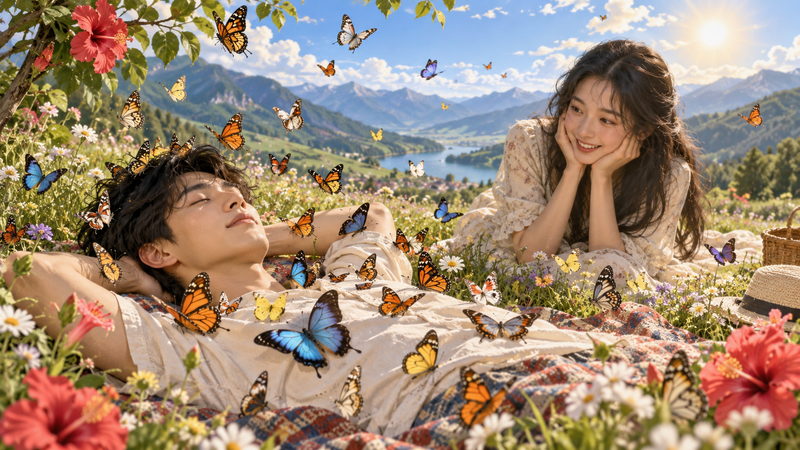
It didn’t take too long, and they came.
First, a couple, three, and then ten, twenty…
Eventually, I lost track of how many butterflies came and parked on my face, my neck, chest, belly, legs. They almost covered my entire body!
Ice’s mouth dropped open, and she stared at me with an incredulous smile.
The butterflies lingered. They’d rise and land and more were still coming.
I told Ice what I had done the previous night. I tried to let the fragrance and sweetness of the flowers permeate through my body and slowly evaporate off my skin. I became the bridge, or medium, between the flowers and the butterflies. For a moment, under the blue sky and bright sun, I participated in their quiet and sacred exchange.
This was my experiment. I didn’t want to simply wait for them to land on me randomly and then try to walk with them, wondering what I could do to keep them longer. I also didn’t want to keep them in a cage, depriving them of their freedom and dreams. I didn’t want to own them. I just wanted to take part in their celebration of life, however briefly. I found a way!
Ice began to laugh and she looked like a flower herself. I think she understood a little of me, and why I kept talking about this insect. I can count that day to be among my happiest.
I never repeated that experience. Those flowers I picked didn’t manage to complete their purpose. My little experiment was just to see if I could share a little of the mystery and wonder, and the joy of dancing in the air. In the end, we all long for the same things. I believe that our spirits – and those of all living things – are enriched by one another as we share the same air that we breathe.
每當我回想起童年,尤其是最初那幾年的歲月,腦海裡浮現的影像似乎總是黑白的。從湖南鄉間,到跟隨母親一路艱辛來到臺灣,再到那棟有圍牆庭院的巨大日式房子,所有的記憶都籠罩著一層灰色的陰影,彷彿在觀看一部古老的黑白電影。
然而,有一樣東西卻深深埋藏在我的心底,對我有著特殊的意義。牠們在池塘邊、灌木叢旁、花朵之間飛舞——蝴蝶。在我的記憶中,牠們永遠色彩鮮明,燦爛耀眼。
我第一次被蝴蝶深深吸引,是在五歲的時候。我整天追逐著牠們,常常忘了自己身在何處;有時被池塘邊的石頭絆倒,有時一頭鑽進帶刺的灌木叢,弄得手腳紅腫發癢。上了幼稚園以後,我交了新朋友,也開始和鄰里的孩子玩更多遊戲。許多遊戲,例如鬥蟋蟀,通常只是男孩子喜歡玩;和女孩子在一起時,我們則玩捉迷藏、跳繩,還有一種叫做「走蝴蝶」的遊戲。
我喜歡鬥蟋蟀,但我更喜歡「走蝴蝶」。玩法是這樣的:每個孩子在院子裡走來走去,想辦法吸引一隻蝴蝶停在自己的身上。等蝴蝶停下來之後,就帶著牠沿著事先規定好的路線走——繞過某些灌木和樹木,走上小塔,穿過天井,再繞過前院……一直走到蝴蝶飛走為止。誰能帶著蝴蝶走得最遠,誰就是贏家。至於怎麼走、走多快,悉聽尊便。
這個遊戲好玩的地方,不只是看每個人如何小心翼翼,不驚動停在自己身上的蝴蝶,更有趣的是看大家千奇百怪的走路姿勢。有人像小偷一樣踮著腳尖;有人像螃蟹一樣橫著爬;有人像小鴨子似的搖搖擺擺;有人兩眼僵直,活像一個木偶;也有人乾脆四肢著地,在地上慢慢爬。還有人每一步都走得痛苦萬分似的,嘴裡不停喃喃自語,彷彿在對蝴蝶甜言蜜語,求牠再多停留一會兒……光是看別人玩,就已經有趣得不得了。我們常常笑得東倒西歪,最後全倒在地上。
可是,我從來沒有贏過。也許是因為我的性子太急。我總想:如果趁蝴蝶還沒弄清楚發生什麼事情以前,猛地往前衝,說不定比慢慢爬還能走得更遠。結果,這一招顯然不太靈。後來我當然又試過其他方法,例如用極其平穩、極其緩慢的動作向前移動。那個年紀我還學會了吹口哨,心想,也許蝴蝶會被音樂吸引呢。
夏天的花季漸漸接近尾聲。我的鬥蟋蟀和紙牌遊戲都沒什麼進步,因此我無論如何都想至少贏一次「走蝴蝶」。有一天,我終於想到了一個辦法。經過觀察,我發現蝴蝶之所以不肯在我身上停留太久,也許是因為我穿著衣服。衣服對牠們來說,畢竟不像灌木、樹木和池塘那麼自然。我注意到,蝴蝶似乎比較願意停在人的裸露脖子或手臂上。
於是,我把衣服全部脫光,蹲在池塘邊,等著牠們飛來。這一下,所有正在玩遊戲的孩子都分了心。有的被我突然全身赤裸嚇呆了,有的笑得前仰後合。我完全不理他們,只專心進行我的實驗。
終於,一隻蝴蝶飛來了,停在我的頭髮上。我踮著腳走了四步,牠飛走了。我又蹲下來繼續等。第二隻蝴蝶來了,停在我的左肩上,可是我才剛站起來,牠就飛走了。我大失所望,決定再試最後一次,不成功就算了。就在這時,我聽見一聲尖叫,從院子的另一頭,穿過遼闊的藍天,直衝過來——
是母親。
她站在後門廊上,氣得臉色發白,嘴巴張得大大的。其他孩子一看情勢不妙,立刻一哄而散,逃向前門。
從此以後,「走蝴蝶」這個遊戲,我被永久禁足了。但是,我可沒有那麼容易放棄蝴蝶。
既然不能再玩那個遊戲,總沒有規定不准我把蝴蝶帶進屋子裡吧。於是,我開始收集毛毛蟲。那時候,我已經上小學一年級了。
我用木片、石頭和小樹枝,替毛毛蟲蓋了一間間小房子。我跟牠們說話,也訓練牠們。我鼓勵牠們乖乖待在自己的房子裡;如果牠們不聽話,我就威脅牠們——當然不是真的——我會想辦法不讓牠們變成美麗的蝴蝶。
可是,過了一陣子,原本二三十隻毛毛蟲,儘管受到我的悉心照顧,還是一隻接一隻地失蹤了。我的照顧可謂無微不至:每天供應新鮮的晨露、嫩嫩的莓葉,甚至還唱歌給牠們聽。
最後,只剩下兩條小小的綠色毛毛蟲。一條頭旁邊有一個橘紅色的小斑點,另一條身上則有一排黑色小點。於是,我給牠們取名叫「紅點」和「黑點」。如果輕輕碰一下牠們的頭,頭部兩側就會伸出兩根鮮黃色的觸角。
沒過幾天,紅點也失蹤了。等我找到牠的時候,牠已經變成一小團綠色的東西,顯然是葬身在某個人的拖鞋底下。幸運的是,就在同一天下午,黑點開始吐絲,慢慢把自己包進一個繭裡。
我當時的興奮,簡直無法形容。牠吐出的絲是白色的,帶著柔和的淡黃色,甚至有一點微微發亮。
我已經記不得究竟等了多少天,或者多少個星期。終於,一隻黑色的蝴蝶破繭而出。牠的翅膀上灑滿了金屬般的藍色、火焰般的紅色,以及明亮的黃色。這是我親手養出的第一隻蝴蝶!牠舒展著翅膀,飛到紗窗上。過了一會兒,又開始在屋子裡優雅地飛翔。我完全看呆了。母親想把牠放出去,我說不行。
「那你準備餵牠吃什麼?」她問。
「晨露,還有花。」我一邊回答,一邊往院子裡跑。
我採了一大把花,插進花瓶裡,再把花瓶放進蝴蝶的房子。其實,那原本是毛毛蟲的房子。如今牠已經變成一個會飛翔的全新生命,但我仍然希望,等牠餓的時候,多少還記得自己從前住過的地方。
過了一會兒,蝴蝶繞著那些花飛了好幾圈。可是令我不解的是,牠並沒有停在花朵上吸食花蜜。牠反而又飛回紗窗,面向著外面的院子,一動也不動。這隻蝴蝶完全不像院子裡那些蝴蝶那麼活潑。牠似乎也不覺得餓。我開始擔心了。
那天晚上躺在床上,我想:把一隻蝴蝶留在人類居住的屋子裡,是不是一件違反自然的事情?我從池塘邊摘回來的那些花,雖然插在盛滿清水的花瓶裡,事實上卻已經開始枯萎。而那隻被囚禁的蝴蝶,也許知道,那些花早已離開枝莖,失去了原本的生命,無法再完成它們應該完成的事情。也許,這就是牠沒有食慾的原因。儘管萬般不捨,我還是決定,第二天一定要把這隻美麗的蝴蝶放走——這隻曾經是我的「黑點」的蝴蝶。
第二天一大早,我就去看黑點。牠已經不在紗窗上了。最後,我在通往天井的走廊上找到了牠。牠靜靜地躺在那裡,一絲生命的氣息也沒有了。
我的眼淚流了下來,心中湧起一股深深的悲傷。
一直到很多年以後,上了大學,我才逐漸明白:黑點破繭而出的那個晚上,我躺在床上反覆思索的那些問題,其實也正是此後一生中,我始終試圖理解和掌握的問題。
因為喜愛蝴蝶,我飼養了毛毛蟲;又因為喜愛牠,我摘下花朵來餵牠。結果,到最後,牠們全都因為我而死去。
蝴蝶與花朵的生命,本來是在陽光、土地與新鮮空氣中生長、享受;花朵孕育著花蜜,蝴蝶按照自己的節奏飛舞。牠們的存在,並不是為了那個小男孩——也就是我。我愛牠們,是因為我欣賞牠們的美,像詩,像畫;我喜歡牠們的自由、燦爛的生命,以及一種美——蝴蝶——與另一種美——花朵——彼此交換生命精華的珍貴過程。那是大自然脈動的一部分。然而,我卻打亂了牠們原有的節奏。我的愛,是一種自私的愛。
也許,在短暫的一刻,我曾經占有了牠們的形體。可是,我的愛並沒有使牠們任何一方得到快樂。恰恰相反,我毀掉了牠們。牠們不會說話,只能默默死去。那或許是一種微弱的抗議,也或許只是用死亡,平靜地表達生命真正的願望。
每一個生命,無論多麼微小,都值得我們尊重。而無論我們多麼喜愛一個生命,也應該讓它在原本屬於自己的世界裡成長,完成自己的生命。
不能再玩「走蝴蝶」,養毛毛蟲的事業也很快夭折了。因此,在後來大部分的少年歲月裡,我覺得自己與蝴蝶之間的關係,大概只能停留在遠遠欣賞牠們。如果偶爾有一隻蝴蝶停在我身上,我就把握機會,陪牠走上一段——牠願意陪我走多遠,我就走多遠。除此之外,我也很少再想到牠們。畢竟,我還有「長大成人」這件正經大事要忙。
上大學一年級的時候,我發現離學校不遠的地方,有一個叫做「蝴蝶谷」的地方。據說那裡生活著各式各樣的蝴蝶,簡直像人間天堂。
那時,我剛開始和一個女孩交往。我給她取了一個綽號,叫「冰」。她很漂亮,卻也有些冷淡,讓人不太容易親近。我告訴她,從小我就渴望讓蝴蝶靠近自己。我喜歡牠們的輕盈和美麗,迷戀牠們奇妙的生命週期,以及牠們與植物世界之間那種近乎魔法般的關係。透過蝴蝶,我第一次如此鮮明、如此深刻地感受到大自然。
冰聳了聳肩。她說:「自然就是自然,你就是你。你跟蝴蝶之間,究竟能有什麼關係?」
也許她從小就是含著銀湯匙出生的吧。我不禁想,她的童年究竟是怎麼過的?她小時候有沒有在院子裡玩過?
我邀請冰一起去蝴蝶谷玩一天,還準備好了三明治和飲料。我從以前的觀察中知道,大多數蝴蝶都很喜歡扶桑花,於是心裡又冒出了一個實驗的念頭。
去蝴蝶谷的前一天晚上,我騎著腳踏車來到附近的鄉間。那裡有成千上萬朵盛開的扶桑花。月光下,我摘下一朵紅花,拔掉中央的花柱,露出裡面白色柔軟、沾滿濕潤黃色花蜜的部分。我用舌尖舔了一下花蜜,味道淡淡的甜。這讓我想起許多童年的往事,因為小時候,我也曾經嚐過扶桑花蜜。
我不知道那天晚上究竟在外面待了多久。一朵接一朵,我想,我大概吸了將近一百朵花的花蜜。
第二天早晨,我去接冰,我們一起來到蝴蝶谷。那天天氣美極了,陽光燦爛,萬里無雲。我們走過草地,穿過樹林,來到一處山坡。哇!到處都是蝴蝶,大大小小,五顏六色,數也數不清。
我們找了一個地方,把毯子鋪在地上。我對冰說:「冰,我想和妳分享一個實驗。不過,請妳不要批評我。這和我小時候的一個夢有關。」
她若無其事地看著我。
然後,我開始脫衣服,一直到全身赤裸。冰的臉一下子紅了,正要開口說話,我卻把手指放在嘴唇上,示意她不要出聲。接著,我靜靜地躺在毯子上,張開雙臂,慢慢放緩呼吸。
沒有多久,牠們來了。
先是兩三隻,接著十隻、二十隻……
最後,我已經不知道究竟來了多少蝴蝶。牠們停在我的臉上、脖子上、胸口、腹部、雙腿……幾乎覆蓋了我的全身!
冰張大嘴巴,帶著難以置信的笑容,呆呆地望著我。
蝴蝶久久不肯離去。牠們飛起,又落下,而且還有更多蝴蝶不斷飛來。
我告訴冰,前一天晚上我做了什麼。我想讓花朵的芳香與甜味滲入我的身體,再從皮膚上慢慢散發出來。我讓自己成為花朵與蝴蝶之間的一座橋,一個媒介。在那一刻,在藍天與燦爛陽光之下,我參與了牠們之間那場寧靜而神聖的交流。
這,就是我的實驗。我不想再只是等待蝴蝶偶然停在我身上,然後一邊走,一邊想著究竟有什麼辦法可以讓牠多停留一會兒。我也不想把牠們關進籠子裡,剝奪牠們的自由與夢想。我不想擁有牠們。我只是想參與牠們對生命的歡慶,哪怕只有短短的一刻。
我終於找到方法了!
冰笑了起來。那一刻,她自己看起來也像一朵花。我想,她終於稍微了解了一點真正的我,也明白了為什麼我總是不停地談起這種小小的昆蟲。那一天,可以算是我一生中最快樂的日子之一。
後來,我再也沒有重複過那次經驗。畢竟,那些被我摘下來的花,也因此沒有能夠完成牠們原本的使命。我的小小實驗,只是想知道,我是否能分享一點那份神祕與奇妙,以及在空中飛舞的喜悅。
到最後,我們所渴望的,其實都是同樣的東西。因為牠們存在於我們的生命之中,我們的精神世界因此變得更加豐富。而我相信,對牠們而言也是如此——因為我們正呼吸著同一片空氣。