Back to Selected Works
Essay
Some Thoughts on Embracing Life / 擁抱生命的情懷
Author: Raymond Ku
|
(Translated from Chinese by Robert Siddens)
Many years ago, while staying on the island of Majorca off the coast of Spain, I encountered many people who one could describe as unique and self-reliant. One of them was a painter named Bob, an American, already in his sixties. His wife, Barbara, was also a painter. They had moved there from California more than ten years before, pursuing simple but richly rewarding lives.
When he was young, Bob served in combat. He suffered a leg wound and was honorably discharged. He moved around after the war, living on his military pension, and he began to paint. He wandered across the United States, searching for the ideal place to settle. But he hated the various restraints that a materialistic world placed on a person's spirit, and the perverse societal norms created by power and greed. So finally, he landed on Majorca.
Bob's house had no electricity: refrigeration relied on ice blocks; at night he lit kerosene lamps. He also refused to travel by air, only willing to drive or take a boat. They had no phone, no computer, no television, nor any of those other modern amenities that we see as necessities.
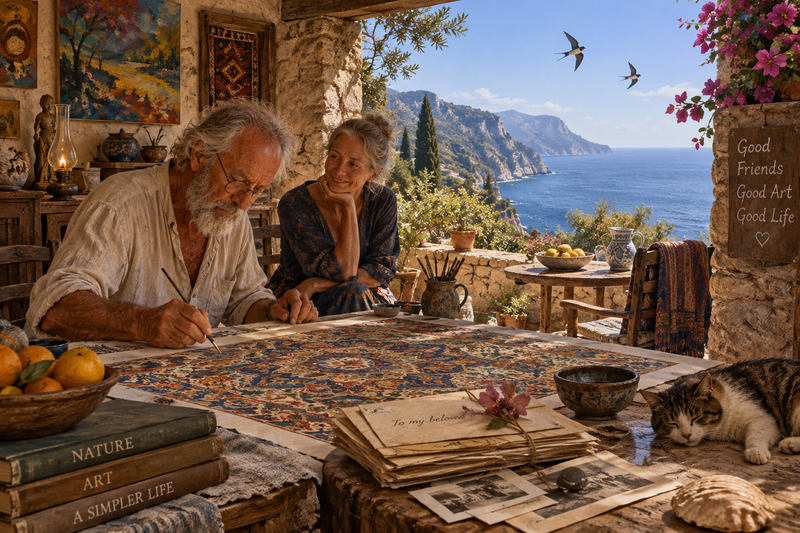
But I liked spending time at his place. Whether it was a small table, a bar stool, a chess stand, a clothes rack, washbasin, fruit bowl, door sill or window frame, everything was Bob's or Barbara's artistic work, designs and arrangements. Some were weavings of yarn, some were ceramic mosaics, while others were plaster statues or sculptural reliefs of hand-made paper. Barbara's oil paintings were lively and brightly colored, semi-abstract, filled with a worship of nature.
I always lost track of time, immersed in an appreciation of this all-encompassing creative world, in this two hundred year old stone cottage, where just out the window was the deep blue Mediterranean Sea, fruit orchard in the courtyard, a profusion of wild flowers. If this wasn't the Garden of Eden, it wasn't far from it!
Actually, Bob's essential creative work wasn't in these hundreds of designs and images. Each day he would spread out a sheet of paper the size of a wall mural, and with acrylic paints and a very fine brush, he would spend six or seven hours carefully and painstakingly painting a carpet design. If you were to see Bob's carpet paintings, which had earned wide acclaim, like me, you would be dumbfounded and deeply moved by the exquisite elegance of these beautiful designs.
One of these gorgeous designs generally cost him nearly a year's effort, but he was never in the least hurry. I couldn't imagine why he insisted on painting such large works on paper. And when with painstaking effort he completed one of these works, he would roll it up and store it in the corner with the rest of these rug paintings. When he had another idea, he would spread out another wall-size sheet of paper and begin the yearlong process again.
Many admirers visited, to appreciate his cottage and courtyard, to look from his balcony out over the Mediterranean as the sun rose and set, in awe of the varied and amazing wonders in his home. But wait until they saw his rug paintings, and they couldn't help but suggest that he take his paintings to a world-class rug maker, to have them made into real rugs so that the public could appreciate his genius. In fact, there had been rug makers who had travelled from afar who were willing to pay handsomely for his designs. But Bob felt that business hadn't the least bit of a relationship with his art. No matter how hard they tried, he would just laugh and ignore them, never once having expressed any interest.
He had never liked to discuss these matters, nor did he wish to promote himself, to seek fame and fortune. He was only interested in living an artistic life of grace and serenity, one with nature, being with friends, like the red-tailed swallows along the Mediterranean cliffs, following their hearts among the pines in the sea breeze and blue sky without a care.
Bob's rug paintings made me think of the "sand rugs" that one often sees in Nepal and Tibet, where in a room, five or six women, or several monks, circle around a large, low platform and use fine sand of various colors to create mandalas. The designs are even finer and more intricate, more brightly colored, than real carpets. A sand mandala of this size (sometimes eight by ten feet, sometimes smaller but at times even larger) may take anywhere from two or three weeks to one or two months to complete. And then, along comes a burst of wind to sweep it all away, and they begin again on the next mandala. It's probably an attitude toward life that comes from their faith. The accumulation of riches and embellishments during a life is like creating a mandala of sand. Once it is completed, the reality and significance of its existence is concluded.
Bob and Barbara certainly weren't followers of an eastern religion. It was just that each day they put their entire selves into living life to its fullest.
Sadly, with the arrival of spring came the news that Barbara had cancer. The island's hospital wasn't equipped to treat her, so she boarded a plane (unlike Bob, she wasn't opposed to flying) to return to California for treatment. A few weeks later, Bob received word that her condition was gradually worsening.
Bob didn't fly. For several days he inquired at freight and shipping companies large and small, finally locating a U.S.-bound freighter. But the ship had to first sail south to North Africa for a stop in Morocco to unload and load, and then spent two weeks crossing the Atlantic to New York. And he would still have a three-day train ride across the continent before finally reaching California. Adding it all up, including stops and transfers along the way, Barbara would have to wait a month before seeing Bob again.
Theirs was a deep love. From the time that Barbara left Majorca, Bob wrote her at least two letters a day, and there was an uninterrupted daily flow of letters from Barbara. Their hand-written letters were copious and detailed, filled with sparkling verbal gems. There were paintings, photographs, songs and poems, and paper cuttings. And there were long passages of tender and intimate words.
When Bob decided to visit Barbara, she sent a letter insisting that he figure out how to travel by boat, absolutely did not want him, because of her illness, to go against his principles by taking the plane. She already had many friends who loved her dearly by her side. She said that all of the events and pursuits of her life, large and small, were all because she had Bob in her life. He had filled her with inspiration, had faced change with her, had grown with her, had appreciated beauty with her and shared her sorrow. Even if they weren't together, their relationship could not change. One could see from their letters: when they were together, their lives were rich and full; when they were apart, their lives were rich and full.
With the best wishes of his friends, Bob embarked on a Mediterranean freighter, a large ship with a captain and crew of twelve. Bob was the one and only passenger. They stopped in Morocco for two days, and he sent a long letter to his friends back on Majorca, describing his experiences at sea. The crew was busy, so he roamed about the boat on his own. Otherwise, he played chess with the captain, sketched members of the crew or sea birds. His letters were very funny, describing the various people and occurrences onboard the ship, as well as the day-in, day-out tedium and boredom. Reading his letters could send one into peals of laughter.
A few weeks went by, and we received a number of letters that Bob sent from New York. When he finally reached California, Barbara had already passed away five days before. Family and friends waited for Bob to arrive, and only then did they hold a memorial service. As she succumbed to the cancer, Barbara never stopped painting, leaving behind a couple dozen works. And each day she wrote in her diary. As the end neared, she dictated a letter to someone, a farewell love letter to Bob. They scattered her ashes over the Pacific Ocean.
Bob remained in California for another ten days or so, and then caught the train back to New York, taking Barbara's paintings with him. As luck would have it, the freighter that had brought him was ready to weigh anchor and return to Europe. He boarded the ship to be pitched and rolled by the waves on a leisurely trip home. Along the way, he played several hundred games of chess.
Whenever I think about the lives of Bob and Barbara, and about their attitude toward life, the enthusiasm with which they embraced life, their self-aware life choices, I was moved to no end. They weren't deceitful self-promoters, nor selfish, nor did they try to impose their opinions and beliefs on others. And they weren't wealthy.
Having stayed on Majorca and experienced a heavenly utopia on earth, what it was like, the atmosphere, having known Bob and Barbara, I could get a feel for how it is that one could select one's own lifestyle, how one could embrace life, how one could love. From this I understand the true riches in life.
很多年前,到西班牙外海的馬約加島上遊玩,在葉子和瑞克的家小住,遇到不少可以說是特立獨行的人物。其中一個名叫鮑布的畫家,美國人,已經六十多歲,太太芭芭拉也是個畫家。十多年前,兩人從美國加州搬來,就一直過著清淡卻充滿情趣的生活。
鮑布年輕時參加過戰役,傷了一條腿,榮譽退役。戰後四處流徙,領了退伍金,便開始畫畫。他在美國東遊西走,尋找理想居住環境。但他厭惡物質世界帶給人精神上的各種鉗制,以及貪婪和權力慾造成的社會乖戾習氣,最後終於落腳馬約加島。
鮑布的屋子裡不用電:冰箱是用大冰塊保涼,晚上點油燈。他也拒絕搭飛機旅行,只願意坐車或乘船。他們沒有電話、電腦、電視或一切我們視為當然的現代文明產物。
但是,我喜歡去他家玩。那裡不管是小桌子、高凳子、棋台,還是掛衣架、洗澡盆、水果盤、門框、窗台,到處都是他和太太芭芭拉的藝術作品、設計或安排。有的是用羊毛染織,有的以瓷塊拼夾,也有石膏雕塑,或手造紙的立體浮雕。芭芭拉的油畫活躍鮮艷,半抽象,但充滿大自然的禮讚。
我每每流連忘返,欣賞這些俯拾即是的創造世界,加上這兩百年老的石屋,窗外就是深藍的地中海,院裡一片果林,四處繽紛野花,如果這不是我夢裡的世外桃源,相去也不遠了吧!
其實,鮑布的主要作品還不在於這些花樣百出的設計、圖像。他每天總要花六、七個小時,張開整面牆一樣大的壁畫紙,用壓克力顏料,細細的筆,一絲不苟地畫他的地毯。
如果你能看到鮑布那些很多人傳誦的地毯畫,一定會和我一樣目瞪口呆,被那精緻又氣派的攝心美景深深感動。
如此華麗的地毯設計,總要花費他將近一整年的功夫。但鮑布毫不匆忙。這麼大的畫,他偏要畫在紙上,使我覺得不可思議。
等他好不容易終於完成了一件作品,他就把它捲起來,往牆角和其它的地毯畫一起擱著。然後,等他有了新的主意,他就會打開另一張像牆一樣大的白紙,從事另一年的地毯繪畫工程。
有多少人慕名而來,欣賞他的屋子庭院,在陽台上看地中海上那令人嘆為觀止的日出日落,驚嘆他屋內的種種。等看了他的地毯畫,都禁不住會建議他把這些設計拿去給世界一流的地毯公司,編織成真正的羊毛地毯,讓大眾都有享受他天才的機會。還有遠地來的地毯編織家,願意出高價買他的設計。
可是,鮑布覺得商業買賣和他的藝術沒有絲毫關係。不論如何,他都打著哈哈,顧左右言他,從沒表示過任何興趣。
關於這種事,他也從來不喜歡高談闊論,或者自我標榜清高什麼的。他只顧瀟灑地、安祥地過他的藝術生活,與太陽白雲為伍,和朋友共渡,如同地中海岩岸上的紅尾燕,在海風藍天鬆木間隨心所欲,自由無拘。
鮑布畫地毯使我想起西藏和尼泊爾常見的“沙地毯”。那個地區,常會在一個屋子裡,看到五六個婦女或幾個高僧,圍在一個偌大的矮平台四周,用各色的細沙編織一幅地毯。它的圖案比真實一般的地毯都更細膩、繁復、鮮艷。一幅這樣大的地毯(有時八英尺乘十英尺,有的小些,有的更大),要兩三個星期到一兩個月才編織完。然後,一陣風掃,它就完全散去。再重新開始設計編織下一幅。大概這就是他們的信仰對於人生的態度。人生不管多璀璨,它只是像用沙編織地毯一樣的一個過程,當它完成了,那個存在的實體和意義也就結束了。
鮑布和芭芭拉並不相信什麼東方宗教,他們只是在每一天,飽滿地活著全部的自己。
後來春天到時,芭芭拉不幸得了癌症,島上的醫院無法治療,她就搭飛機(她
不反對飛機)回美國加州去求醫。過了幾個禮拜,鮑布得到信息說她的病情漸漸
惡化。
鮑布是不坐飛機的。他向大小幾個輪船和航運公司詢問了好幾天,終於找到一
班開往美國的貨運船;可是它得先往南開到北非的摩洛哥,在那兒停下來裝卸貨,然後花兩個禮拜渡過大西洋到紐約東海岸。從紐約,他還得乘三整天火車橫貫大陸才到得了加州。全部加起來,連等船,停泊,轉程,芭芭拉得繼續等一個月才見得到鮑布。
他們的愛情深厚,自從芭芭拉離開馬約加,鮑布每天至少寫兩封信,芭芭拉也
天天不斷地的來信。他們的手寫的信,內容可是洋洋灑灑,琳瑯滿目。有圖畫、照片、詩歌、剪貼,和長長的生活細語,及綿綿情話。
鮑布決定去看望芭芭拉時,芭芭拉在信裡堅持要他設法搭船走海陸返回,決不
要為了她的病改變他一生的理念而搭飛機。她有很多熱愛她的朋友在身邊。她說她這一生大大小小的變故和追求,都因為有鮑布在她生命中,給她充沛的激勵,一同面對變遷,經歷成長,分享美麗,分擔哀愁。和鮑布即使不在同一個地方,這個相聯絲毫不變。
從他們來往的信函可以看出,當他們在一起時,他們豐富地生活;當他們不在一起時,也一樣的豐富。
鮑布在朋友的祝福中上了地中海貨輪。偌大的船上,船長、船夫等等一共十二
個人,鮑布是唯一的乘客。到摩洛哥他們停了兩天,他寄了封長信給馬約加的朋友,描寫他的海上經驗。船員們忙,他就獨自在船上東晃西晃。要不就與船長下棋、給船夫、海鳥作素描。他的信很幽默,形容船上諸人諸事,以及日復一日的單調無聊,讀了會叫人頻頻大笑不止。
過了幾個禮拜,朋友又收到鮑布從紐約寄來的幾封信。當他終於到達加州,芭芭拉已經在五天前去世了。家人朋友直等鮑布到了才辦喪禮。芭芭拉病中不停地畫畫,留下兩打作品,並且每天寫日記。臨終,口敘由他人寫了一封給鮑布的告別情書。他們把芭芭拉的骨灰灑落太平洋。
鮑布在加州停了十多天,帶了芭芭拉的作品乘火車回紐約,正巧,原來的地中海貨輪也準備好起錨回歐洲,他又搭上船,一盪一晃,慢吞吞的回來。一路上,下
了好幾百盤棋。
每當想起像鮑布和芭芭拉的人生態度及內容,他們擁抱生命的激情,能自知的取捨,我都會感動不已。他們不濫情、自我標榜、自私,他們從不與別人談論或炫耀自己的理念和才氣,他們也沒有什麼財富。
在馬約加住過,讓我親身經驗了人間的世外桃源,會是個什麼面貌,什麼氣氛;認識了鮑布和芭芭拉,也讓我感受到人是怎麼能去選擇自己的生活方式,去擁抱生命,去愛。我也由此明白,什麼是真正的富有。