Back to Selected Works
Essay
The Gates of Eden / 天堂之門
Author: Raymond Ku
|
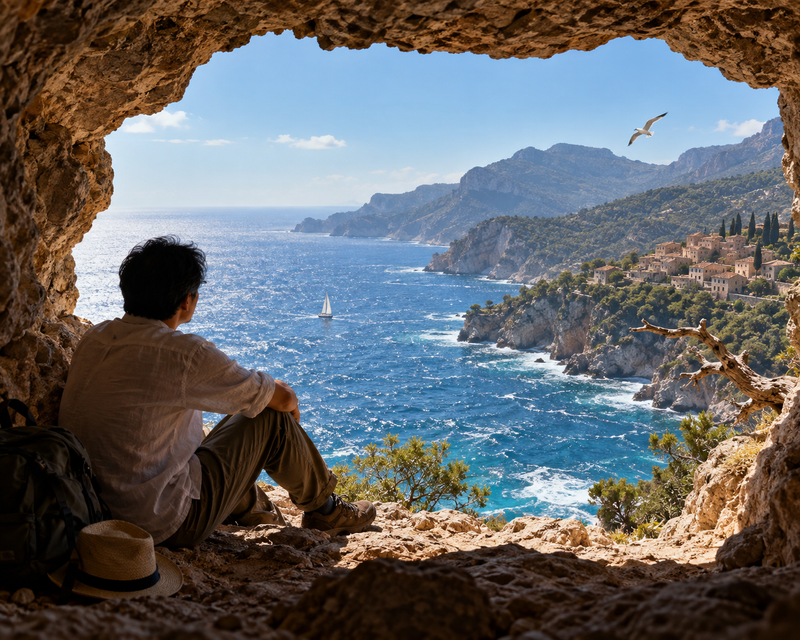
On a high cliff overlooking the Mediterranean Sea, I crawled into a shallow cave that angled back into the rock. On this northern side of the island, there were almost no people. Besides the blue sky and the azure sea with its white caps, the only other thing that one could see from the cave was an occasional seabird flying up from the waves to
land on a withered branch along the cliffs.
I let my thoughts soar unrestrained with the wind. This cave, small and hidden yet so majestic, had to be the perfect place in the whole world for thinking wild and fanciful thoughts, or making love.
I had already been to the island of Majorca several times before. I had invited a friend to come along this time, but there was no way that he could get away from his business just then. In recent years, we had traveled together through many different countries. As we traveled about, we always compared notes on what each envisioned as the ideal place, the worldly paradise.
Is paradise something a person earns through hard work, or obtains by chance? Or is it the God-given right of a chosen few? I was always asking him this question. He liked to vacation in the Bordeaux countryside of southern France. Sometimes, he brought up Rio in Brazil. As for me, whenever I had the chance, I would head for Majorca.
My friends Rick and Yets lived in a small village called Deya on the northern coast of the island. Nestled between the mountains and the sea, Deya had been for years internationally famous as an artist colony. A number of accomplished painters and writers, those who had already gained their fame, lived here in seclusion. Those who were still working on their masterpieces had their own circles here. Most people who lived here were young people who did nothing in particular and who did not have to worry about earning a living. They came to the island in the summer and seemed to think that by immersing themselves in the fertile artistic atmosphere of Deya, free from the restraint of worldly cares, they would be infected with the mysterious artistic inspiration.
But there were those here who didn't have it quite so good. I once went with Rick and Yets to Soller, a relatively larger city near Deya, to visit a couple of their friends. The man was a German handicraft designer named Horst. The woman was a Thai named Penny, with dark, liquid eyes and long jet black hair that fell straight down her back.
They had met Rick and Yets in Australia. Once they had heard all about Majorca, they decided to use every means at their disposal to earn and save money in order to come and settle on this beautiful island. They did some research and decided to open a Thai restaurant in Soller.
Horst's fine and meticulous craftsmanship was unsurpassed anywhere. Penny and he had purchased from Thailand several marble and teak tables and chairs of an exquisite quality, as well as stone-carved Buddhist statuary. They hired a young chef all the way from Thailand and completely redecorated the place. Horst designed and constructed it himself, in a very elegant and refined style.
That day we were sitting in their courtyard enjoying the shade of a loquat tree. Their chef, who spoke neither English nor Spanish, fixed us something to eat and then sat submissively on a straw mat, drinking a glass of iced mint tea. Horst, whose bare chest had long since been deeply bronzed from tanning in the sun, reclined on a patio chair and told us of his plans.
"This is really the ideal combination," he remarked leisurely. "We open the restaurant for two or three hours a day. If we have 15 or 20 customers, that's enough to support us."
Rick asked him if it included the money he had borrowed from the bank to buy the building. Sooner or later, he'd have to pay it back. Penny said that the chef was getting more and more bored as the months went by. Because of the language and culture barrier, except for Penny, there was no one for him to communicate with.
There was also present at our gathering that day an American photographer who had only recently arrived on the island, had searched all over for a house to buy and was moving in next month. In addition, there was a German songwriter and his wife who had already been living on the island for ten years. They spent six months of every year here and the rest of the year in Hamburg. Eventually, a tall, thin woman appeared at the garden fence. Horst jumped up out of his chair and over to greet her. He introduced her to me as his neighbor, a Spanish woman named Christina. She was an artist, a weaver, and I noticed a change in Penny's expression.
What do the beautiful people do, once they have escaped to a worldly paradise and don't have to worry about the entanglements of the real world? Is all they have the brilliant sun, the blue skies, the turquoise sea and mountainous coast?
Christina and Horst were really hitting it off, with the kind of enthusiasm one sees between new friends. Penny was beginning to lose her train of thought. Every time she started to speak, she didn't finish her sentence. I stood up and went to admire the fruit trees in the garden. Besides the loquat tree, there was a small kumquat tree and several fig trees (It was the first time in my life that I had tasted a fresh fig), cherry, apricot and olive trees.
I had been thinking over some of the possibilities. A few years before, the first time I had come here, I had discussed with Yets the idea of our exchanging houses with them for a year. I would ask for a year's leave from my company, come to Spain and using her house as my base of operations, travel all over southern Europe. For their part, they could stay in one of my places in Chicago and from there travel all over the United States. But in truth it was all much easier said than done. There were far too many conditions and factors that it all depended on. When I think about it now, I realize it was all a pipe dream.
The general consensus among the group in the garden that day was that very many of those who came to the island were not necessarily wealthy. But rather, because the level of consumption was low, and because there were none of the enticements of the big city, a person ought to live quite well on four or five hundred dollars a month. But money wasn't the most important issue. I figured that even if I quit my job in Chicago, sold my houses and moved the whole family to Majorca, would I really want to spend the rest of my life in what I imagined to be a worldly paradise, to be in eternal harmony with the rest of the world, enjoy a free and easy life to my heart's content? Sometimes writing, sometimes working at my computer.
Actually, with regard to my career, I had the usual ambitions. As for the reality of my leaving Chicago, I had not the least regret to it. On the contrary, under the stress of work and a life that made it hard to catch my breath, I often dreamed that I could quickly return to Majorca, to find a little peace and tranquility and to get back to nature.
So, why was it so difficult for me to make the decision? The time we visited Penny and Horst, it was the beginning of spring. Five or six months later, at the end of summer, on a trip to London I stopped over in Majorca again.
The first thing Yets said when she saw me was to tell me that Horst and Penny had separated. Their restaurant, along with the teak and marble furnishings and Buddhist statues, had already been sold off. In fact, Horst had just boarded the boat for Morocco. The subservient chef had already returned to Thailand.
We went to Soller to visit Penny. What had been a restaurant with elegant and refined atmosphere was now piled high with large and small boxes in preparation for a move. Penny did not look good. Her smile was one of bitterness and resentment. I asked Yets whether Christina had been the cause of all this. "It was that, and many, many other things."
Last spring everyone had envied how they had set it all up, had been so admiring of their restaurant and all its trappings. And by fall all that was left was a heartbroken Penny, who didn't know whether to return to Thailand, go back to Germany (where she had lived for more than ten years and which she considered her second home) or go to Australia. Or, she could stay on in Majorca and see if she couldn't turn up some new opportunities.
I lingered for a while by the pond in the garden with its many fruit trees. Everything about this villa exuded an ambience of old Spain. I could have bought it up in a single breath, and not for the headache of starting a restaurant. Living in a world like this, why worry about running some common business? I couldn't sleep that night. At about two in the morning, suddenly from the foothills came the sound of someone revving up a motorcycle engine, sending a long and distant echo through the valley. After all these visits here, it hadn't occurred to me until then that this place, too, had its share of wild teenagers, living a life of monotony, always in a hurry to acquire the means to lead a life of total hedonism.
In the morning, as soon as I got out of bed, I took a hike to the cliff cave overlooking the sea, just to be absorbed into the beauty of the place.
Yets and Rick had already lived seven or eight years on the island. They had made preparations to sell their house and return to Australia. From the way Rick sounded, it seemed as if he wanted to get out just as fast as they could. Yets said that one could never think of raising children here, or else they would be just like the local kids, and know no better than to start motorcycles in the middle of the night and disturb the entire village.
My traveling companion and I had once been traveling together on the Greek island of Corfu. Again I asked him, Is paradise something that a person earns? Or finds by chance? Or is it the special right of some? He answered that it was none of these. Paradise only exists in one's mind.
I still want to return to Majorca as soon as I get the chance. It doesn't matter whether Penny and Horst are there. It doesn't matter that Yets and Rick are already far from there. And it doesn't matter what my friend says.
在一處俯瞰地中海的高崖上,我爬進了一個向岩壁深處斜伸進去的淺洞。島的北面幾乎杳無人跡。從洞裡望出去,除了藍天、湛藍的海水和浪尖上的朵朵白花之外,偶爾能看到的,就只有一隻海鳥從浪濤間飛起,停落在懸崖邊一根枯萎的樹枝上。
我任憑自己的思緒隨風無拘無束地飛翔。這個洞穴,小巧、隱祕,卻又如此壯麗。我想,整個世界大概再也找不到比這裡更適合胡思亂想、馳騁幻想,或者做愛的地方了。
在這之前,我已經來過馬略卡島好幾次。這一次原本也邀了一位朋友同行,可惜他的生意實在脫不開身。近幾年來,我們曾經一起旅行過許多不同的國家。每到一處,我們總喜歡交換彼此的看法,討論各自心目中理想的地方——那個所謂的「人間天堂」。
天堂究竟是靠一個人努力掙來的,還是偶然碰上的?或者,那根本就是上帝賜給少數幸運兒的特權?我總是這樣問他。他喜歡到法國南部波爾多的鄉間度假,有時也會提起巴西的里約。至於我,只要一有機會,就往馬略卡島跑。
我的朋友瑞克和葉子住在島嶼北岸一個名叫德亞(Deya)的小村莊。德亞依山傍海,多年來一直是國際知名的藝術家聚居地。一些已經功成名就的畫家和作家隱居在這裡;那些仍在埋頭創作自己「傳世傑作」的人,也各有自己的圈子。
不過,住在這裡的大多數還是些年輕人。他們似乎沒有什麼特別的事情可做,也不必為謀生操心。夏天一到,他們便來到島上,彷彿只要把自己浸泡在德亞肥沃的藝術氣氛之中,擺脫塵世生活的種種束縛,就會自然而然感染上某種神祕的藝術靈感。
然而,住在這裡的人,也並非每一個都那麼逍遙自在。
有一次,我和瑞克、葉子一起到德亞附近一個比較大的城市索列爾(Soller),去探望他們的一對朋友。男的是德國人,名叫霍斯特(Horst),從事手工藝設計;女的是泰國人,名叫佩妮(Penny),有一雙深邃、水汪汪的黑眼睛,一頭烏黑的長髮筆直地垂到背後。
他們是在澳洲認識瑞克和葉子的。聽他們把馬略卡島說得那麼迷人,兩人便下定決心,想盡一切辦法賺錢、存錢,好搬到這座美麗的島上定居。經過一番研究之後,他們決定在索列爾開一家泰國餐廳。
霍斯特的手藝極其精細,幾乎無人能及。他和佩妮從泰國買來了一批精美的大理石和柚木桌椅,以及石雕佛像,又特地從泰國請來一位年輕廚師。他們把整個餐廳徹底重新裝修,全部由霍斯特親自設計、施工,風格十分高雅精緻。
那一天,我們坐在他們家的庭院裡,享受著枇杷樹下的陰涼。那位既不會說英語、也不會說西班牙語的廚師替我們做了一些吃的,然後安安靜靜地坐在一張草蓆上,喝著一杯冰涼的薄荷茶。霍斯特赤裸著上身,長年日曬已使他的皮膚呈現深深的古銅色。他斜靠在庭院的椅子上,向我們談起他的計畫。
「這真是最理想的組合。」他悠閒地說,「餐廳每天只開兩三個小時。只要有十五、二十個客人,就足夠我們生活了。」
瑞克問他,這樣的收入是否也包括償還向銀行借來購買這棟房子的貸款?那些錢早晚總是要還的。佩妮則說,那位廚師這幾個月來越來越無聊。由於語言和文化上的隔閡,除了佩妮之外,他幾乎找不到任何可以交談的人。
那天聚會的客人中,還有一位剛到島上不久的美國攝影師。他已經四處找到了準備購買的房子,下個月就要搬進去。另外還有一位德國作曲家和他的妻子,他們已經在島上生活了十年,每年有六個月住在這裡,其餘時間則住在漢堡。
後來,一個高高瘦瘦的女人出現在花園的籬笆旁。霍斯特立刻從椅子上跳起來,走過去迎接她。他向我介紹說,那是他的鄰居,一位名叫克莉絲蒂娜(Christina)的西班牙女人。她是一位藝術家,從事編織創作。
就在那一刻,我注意到佩妮臉上的表情變了。
當這些美麗的人終於逃進了「人間天堂」,不再需要為現實世界的種種糾纏煩惱之後,他們究竟做些什麼呢?難道他們所擁有的,就只是燦爛的陽光、蔚藍的天空、碧綠的海水和起伏的山巒海岸嗎?
克莉絲蒂娜和霍斯特談得非常投機,那種熱絡,正是新朋友之間常見的興奮。佩妮卻開始有些心不在焉。她每次開口說話,話講到一半便停了下來。
我站起身,到花園裡去欣賞那些果樹。除了那棵枇杷樹之外,還有一棵小小的金橘樹和幾棵無花果樹——那也是我有生以來第一次吃到新鮮的無花果——此外還有櫻桃樹、杏樹和橄欖樹。
其實,我一直在思考一些可能性。幾年前第一次來這裡時,我曾經和葉子談過一個構想:我們兩家交換房子住一年。我可以向公司請一年長假,到西班牙來,以她的房子作為基地,四處遊歷南歐;而他們則可以住進我在芝加哥的一處住所,以芝加哥為基地,遊遍美國。
然而,說起來容易,真正做起來卻完全不是那麼回事。這件事牽涉的條件和因素實在太多。現在回想起來,我才明白,那不過是一場白日夢。
那一天,花園裡大家談到最後,得到一個共同的看法:來到這座島上的人,很多其實並不富有。只是因為這裡生活費低,又沒有大都市裡那麼多誘惑,一個人每個月花四、五百美元,大概就可以過得相當不錯。
可是,錢並不是最重要的問題。
我想,即使我真的辭掉芝加哥的工作,賣掉房子,把全家搬到馬略卡島,我真的願意在這個自己想像中的「人間天堂」裡度過餘生嗎?從此與世界永遠和諧相處,隨心所欲地享受自由自在的生活?有時寫寫東西,有時在電腦上做點事情。
其實,在事業方面,我和一般人一樣,也有自己的企圖心。至於離開芝加哥這件事本身,我倒一點也不會捨不得。恰恰相反,在工作壓力和令人喘不過氣的生活中,我常常夢想著能夠趕快回到馬略卡島,尋找一點平靜與安寧,重新回歸自然。
那麼,我為什麼始終如此難以下定決心呢?
我們那次去看佩妮和霍斯特時,正是初春。五、六個月以後,夏天已接近尾聲。我去倫敦旅行途中,又一次順道來到馬略卡島。
葉子一見到我,第一句話就是告訴我:霍斯特和佩妮已經分手了。
他們的餐廳,連同那些柚木、大理石家具和佛像,都已經全部賣掉。事實上,霍斯特剛剛登上前往摩洛哥的船。那位沉默順從的泰國廚師,也早已回到了泰國。
我們到索列爾去看佩妮。原先那間氣氛高雅精緻的餐廳,如今堆滿了大大小小準備搬家的紙箱。
佩妮的氣色很不好。她的笑容裡帶著苦澀和怨恨。
我問葉子,這一切是不是克莉絲蒂娜造成的。
「是,也不只是。」她說,「還有很多、很多其他的事情。」
就在上一個春天,所有人還羨慕他們所建立起來的一切,讚嘆他們的餐廳,以及裡面那些精心布置的陳設。可是到了秋天,剩下來的只有一個心碎的佩妮。
她不知道自己究竟應該回泰國,還是回德國——她曾經在那裡生活十多年,早已把德國視為自己的第二故鄉——或者乾脆再回澳洲。當然,她也可以繼續留在馬略卡島,看看是否還能找到新的機會。
我在那個種滿果樹的花園池塘旁徘徊了好一會兒。這棟別墅的一切,都散發著古老西班牙的氣息。
我甚至可以一口氣把它買下來。
但我可不想自找麻煩,再去開什麼餐廳。
生活在這樣的一個世界裡,又何必為經營一門世俗的生意操心呢?
那天晚上,我失眠了。
大約凌晨兩點,山腳下突然傳來有人猛催摩托車引擎的聲音。轟鳴聲穿過山谷,拖出一道漫長而遙遠的回音。
來過這裡這麼多次,我直到那一刻才突然想到:原來這個地方也有它自己的狂野少年。他們同樣生活在單調之中,同樣急切地想弄到足夠的條件,好讓自己能夠過上一種徹底縱情享樂的生活。
第二天早晨,我一起床,就徒步走到那個俯瞰大海的懸崖洞穴,只想讓自己完全融入眼前的美景之中。
葉子和瑞克已經在島上住了七、八年。他們正在準備賣掉房子,搬回澳洲。
聽瑞克說話的語氣,彷彿恨不得越快離開越好。
葉子說,在這種地方絕對不能想著養孩子。否則,他們將來也會變得和當地那些孩子一樣,除了半夜發動摩托車、吵醒整個村莊之外,什麼也不懂。
有一次,我和那位經常一起旅行的朋友同遊希臘的科孚島。我又問他:「天堂究竟是靠一個人努力掙來的?還是偶然找到的?或者,是少數人才享有的特殊權利?」
他回答我說,都不是。
「天堂只存在於一個人的心裡。」
可是,只要一有機會,我仍然想盡快再回到馬略卡島。
佩妮和霍斯特還在不在那裡,並不重要。
葉子和瑞克是不是早已遠走他鄉,也不重要。
至於我的朋友怎麼說——
也不重要。